Blazing Fast APIs: Next.js And Elysia Js
Explore how the Elysia framework is changing the game for Next.js APIs. By leveraging the Bun runtime for speed and offering seamless end-to-end type safety, Elysia solves the problem of API "file sprawl" and provides a robust, deployable alternative to standard Next.js route handlers.

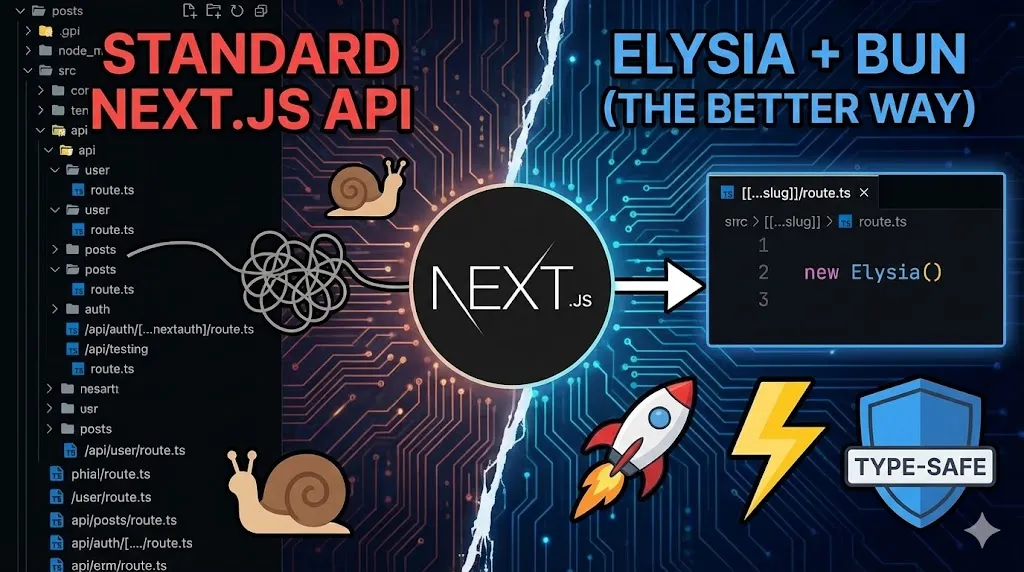
Revolutionize Your Next.js APIs: The Power of Elysia
In the rapidly evolving landscape of web development, speed, type safety, and ease of deployment are paramount for building robust APIs. While Next.js has become a go-to framework for full-stack React applications, its standard approach to building API routes can sometimes feel verbose and fragmented. Enter Elysia, a lightweight, community-driven, and incredibly fast framework that is changing the game for Next.js developers.
This article explores how Elysia seamlessly integrates with the newest Next.js 16, offering a superior alternative for building high-performance, type-safe APIs that are immediately deployable to platforms like Vercel.
The Problem with Traditional Next.js API Routes
Conventionally, creating API endpoints in Next.js involves a file-based routing system where each endpoint corresponds to a separate file (e.g.,route.ts).

While intuitive at first, this approach can lead to:
File Sprawl: As your application grows, managing a multitude of individual route files becomes cumbersome.
Redundant Code:
Implementing similar logic across multiple files can violate DRY (Don't Repeat Yourself) principles.
Developer Friction: Navigating and maintaining a sprawling directory of API routes can slow down development.
For complex applications with numerous features like user management, authentication, and data processing, this method quickly becomes messy and inefficient.
What is Elysia ?
Elysia is an ergonomic framework for humans.
Ok, seriously, Elysia is a backend TypeScript framework that focuses on developer experience and performance.
What makes Elysia different from other frameworks is that:
Spectacular performance comparable to Golang.
Extraordinary TypeScript support with type soundness.
Built around OpenAPI from the ground up.
Offers End-to-end Type Safety like tRPC.
Use Web Standard, allows you to run your code anywhere like Cloudflare Workers, Deno, Bun, Node.js and more.
It is, of course, designed for humans first.
Although Elysia has some important concept but once get the hang of it, many people find it very enjoyable, and intuative to work with.
Enter Elysia: Speed, Simplicity, and Type Safety
Elysia is a modern web framework designed from the ground up for performance and developer experience.
It is the first major framework to leverage the
Bun
runtime by default, capitalizing on Bun's exceptional speed to deliver impressive benchmarks, handling millions of requests per second.
Key Advantages of Elysia:
Blazing Fast Performance: Built on top of the ultra-fast Bun runtime, Elysia's performance rivals that of languages like Go and Rust, ensuring your APIs can handle high loads with minimal latency.
End-to-End Type Safety:
Elysia, through its "Eden" treaty, provides seamless end-to-end type safety.
Define your API schema on the server, and it automatically propagates to your client-side code, eliminating entire classes of bugs related to data type mismatches without any code generation.
Delightful Developer Experience:
Its clean and expressive API, reminiscent of frameworks like Hono or Express, makes defining routes, handling requests, and managing middleware straightforward and enjoyable
Standard Compliance:
Elysia is WinterCG compliant, meaning it adheres to an open standard for JavaScript runtimes.
This compliance ensures interoperability and allows for seamless deployment to diverse environments, including serverless platforms like Vercel, Netlify, and AWS Lambda.
The "Better Way": Integrating Elysia with Next.js
The true power of Elysia for Next.js developers lies in its ability to act as a centralized request handler within a single Next.js API route. Instead of creating dozens of individual route files, you can create one "catch-all" route that forwards all incoming API requests to an Elysia server instance.
How It Works:
Create a Centralized Route: In your Next.js
appdirectory, you create a file likeapp/api/[[...slug]]/route.ts. This catch-all route will intercept all requests made to/api/*.Define the Elysia Server: Within this file, you initialize an Elysia app and define all your API routes, handlers, validation logic, and more using Elysia's clean syntax.
TypeScript
// app/api/[[...slug]]/route.ts
import { Elysia, t } from 'elysia'

const app = new Elysia({ prefix: '/api' })
  .get('/', () => 'Hello from Elysia!')
  .post('/user', ({ body }) => {
      // Type-safe body handling
      return `User ${body.name} created!`
  }, {
      body: t.Object({
          name: t.String(),
          age: t.Number()
      })
  })

export const GET = app.handle
export const POST = app.handle
// Export other methods as needed
Next.js Handoff: You then export the Elysia app's handler function for the HTTP methods you wish to support (e.g.,
GET,POST). Next.js will now delegate request handling for this route to Elysia.
This single-file approach drastically simplifies API management, bringing all your related backend logic into one cohesive and easy-to-maintain location.
Seamless Deployment on Vercel
A major advantage of this approach is its immediate compatibility with popular deployment platforms. Vercel, the creators of Next.js, have officially announced support for Elysia. Their platform automatically detects Elysia applications and provisions the optimal infrastructure to run them efficiently, whether as serverless functions or on the edge.
This means you can enjoy the development benefits of Elysia without sacrificing the seamless deployment workflow you're used to with Next.js on Vercel.
Conclusion
Elysia presents a compelling and modern solution for building APIs within the Next.js ecosystem. By combining the blazing speed of the Bun runtime, the convenience of a centralized route handler, and the robustness of end-to-end type safety, it addresses many of the pain points associated with traditional Next.js API development.
For developers looking to build high-performance, maintainable, and type-safe APIs that are ready for the future, adopting Elysia within your Next.js projects is a powerful and forward-thinking choice. It's time to leave the file sprawl behind and embrace a better way to build.



Comments
0 Comments
Join the conversation